For a long time, the widest native option in the Hasselblad X ecosystem was the excellent XCD 21mm f4. By now (dec 2024) the 20-35mm zoom has been released and is readily available. The 21mm now seems to be discontinued. 20mm on the 33x44mm medium format sensor gives an angle of view of about 108 degrees, which corresponds to about 16mm in full-frame terms. That does not qualify as an ultrawide lens in my book, and 108 degrees is often not enough for the widest scenes.

I have owned the xcd 21mm since it came out. It is an optical marvel, and second only to my 35-75mm zoom in use. From what I have read, the new 20-35 is also an excellent lens. I’m guessing two factors prevent Hasselblad from making an even wider option. First, it will be a very specialized item, with a limited number of buyers. Second, as Hasselblad is very focused on optical quality and ultrawides are difficult to make, such a lens would be big, heavy and extremely expensive. With a limited market, that would not make sense for Hasselblad. I don’t expect to see a XCD 12/14/16mm f2.8 any time soon… For now, we are limited to third-party adapted lenses for the ultrawide end.
Why ultrawide?
So, why do I feel the need for an ultrawide lens on my Hasselblad X? For many years my widest option was the hcd 28mm on my Hasselblad H-system. That corresponded to approximately 17mm in full-frame terms. When I needed something wider, I either had to stitch a pano or resort to my older Nikon d800e and the Nikkor 14-24mm f2.8. As I grew into the X-system, often bringing both the X2D and the X1D, I couldn’t bother bringing the Nikon system too, just in the rare case I needed something very wide. In special circumstances I would adapt the Nikkor 14-24 to my Hasselblad X, but the lack of an aperture ring as well as the size and weight of that lens often prohibited me from bringing it. Also, 14mm was not always wide enough. So, every time I needed something ultrawide, stitching was the only viable option.
Isn’t stitching an option?
Stitching is a convenient technique in many situations, and I have used it extensively. With good technique, a fast computer and the right software, it is mostly a breeze to make a 120 degree panorama. In addition to capturing a wider field of view, you even get the bonus of increased resolution and sharpness. However, there are a few situations where I find stitching to be a real pain. First, if you have a backlit scene that calls for an HDR-solution, you will be looking at a high risk of artifacts and fair amount of work. Second, if you photograph anything moving, such as waves in a seascape or branches in a windy forest, it is a real struggle to get a good result. Third, straight lines such as the horizon or buildings will likely be distorted in the stitching-process and may be a pain to clean up. Finally, if you are shooting the sunstar (as below) you will definitely see some issues with the beams when merging a pano.
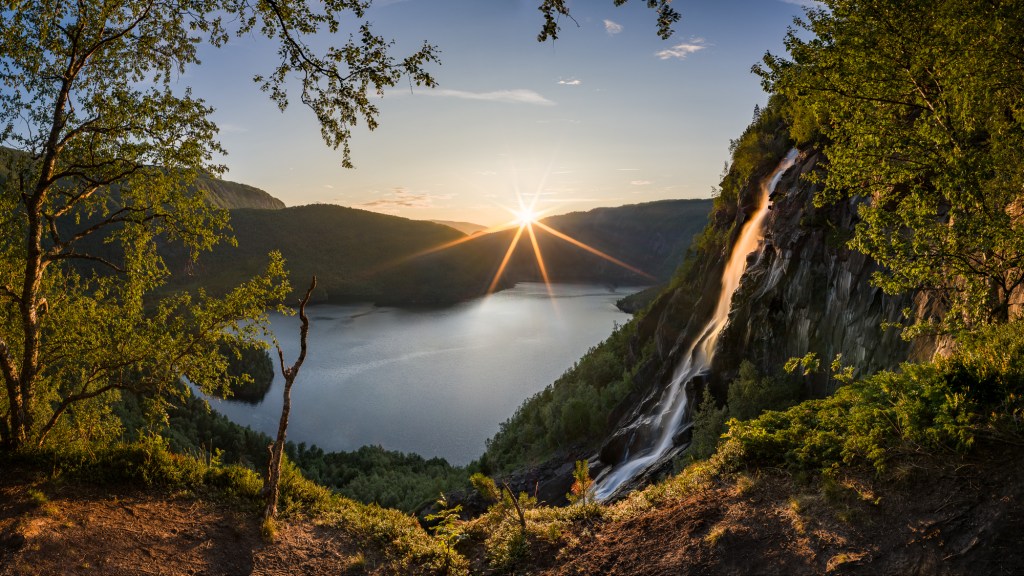
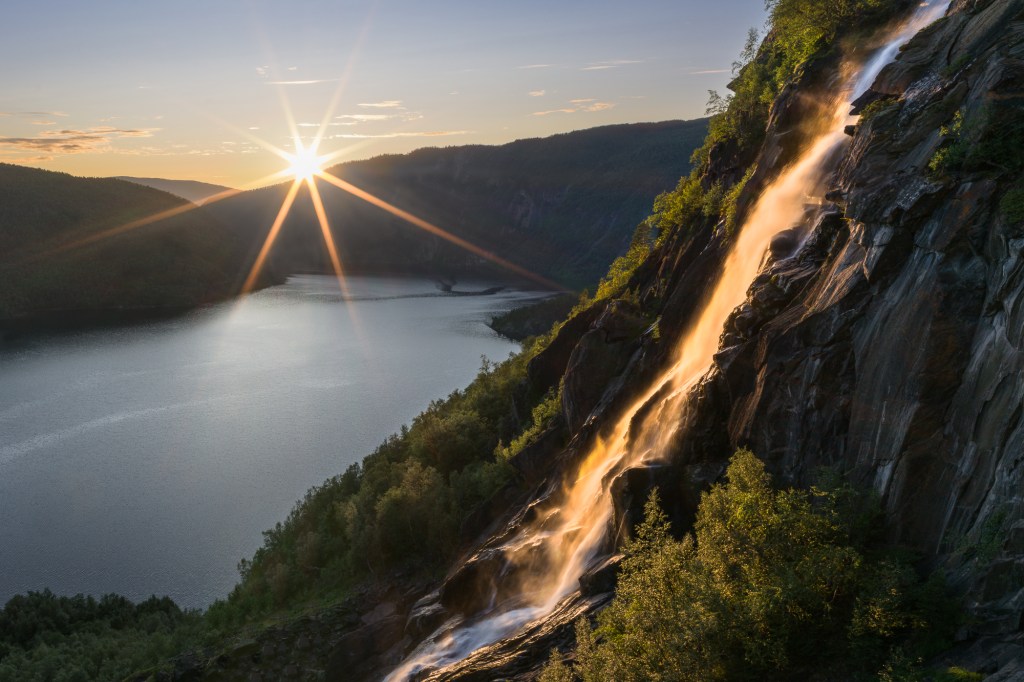
The thought of getting an adapted third party ultrawide first dawned on me when I captured the image above. This is a 5 verticals stitched HDR-panorama, all in all 15 raw- files. The problem I had with the initial result was twofold. First, the patterns in the lake below came out weird as there was some movement in the water and changes in light throughout the 15 exposures. Second, the slight movement of the foreground branches gave lots of artifacts. The result was several weird areas in the stitched file that dictated manual clean up. I ended up working many days before I got a result I was satisfied with.
The need for an ultrawide further materialized during this summer’s trip to Algarve, Portugal. The wonderful vistas of the dramatic cliffs often called for a wider angle of view than my 21mm could provide. I ended up stitching many of the scenes with the same problems as noted above. In particular for seascapes, getting wave-patterns to match between the stitched exposures can be a real struggle. A level horizon also frequently poses a challenge, so do weird distortions of other straight lines from the stitching-process. Stitching anything with buildings can be a nightmare for the same reason. I often use an ND-filter to smooth the water in my seacapes. Exposure-times of a minute or more complicates stitching too, as clouds and light change fast around sunset or sunrise. Although an ND-filter might reduce the wave-pattern problem, it doesn’t help with getting a straight horizon.
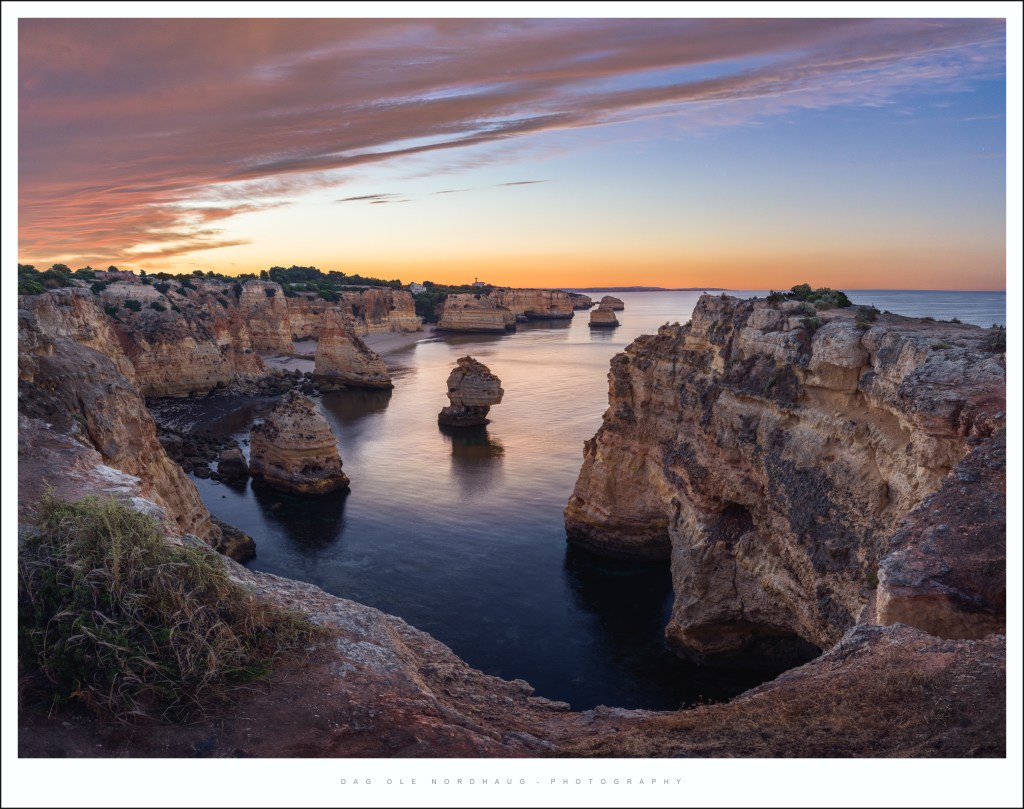
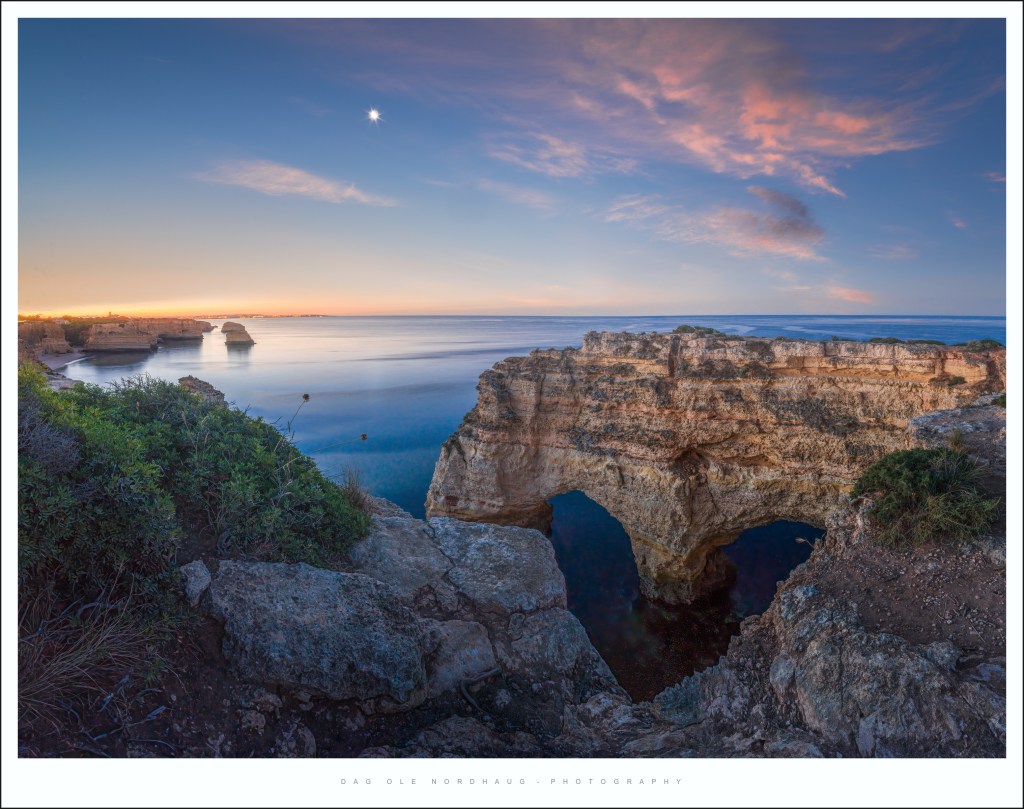
Another use for an ultra-wide is the “deep-landscape”, with a dominant foreground and a striking background. In most circumstances I find the xcd 21mm to be sufficient in these situations (I even sometimes prefer the xcd 30mm), but for selected scenes, like the image below, an ultrawide would be the easier choice.

Which ultrawide?
My conclusion this autumn was that I needed something wider than my xcd 21mm to avoid stitching and simplify the workflow for some of my widest scenes. My research started.
In the tele-end I have had very good results with different other medium-format lenses, such as the Mamiya and Pentax 645 lineups. Still, these systems are very limited in the wide end, often stopping at around 35mm before going fish-eye. In other words, I was limited to full-frame lenses, with the restrictions of a smaller image circle. However, as a panorama of a wide scene often ends up as a 1:2 or 1:3 crop, most of the vignetting might be avoided. The excellent in-camera crop function of the Hasselblad X2D makes composing single-shot panos quite a fun process. I have no problems with using the 2:3 full-frame crop either, the resulting file is still around 68 megapixels. And I might add that I always work on a tripod with more or less stationary subjects and never feel bothered by using manual focus/aperture and the electronic shutter.
Many full-frame ultrawides can be adapted to the Hasselblad X-system. The Laowa line-up caught my attention as I’ve had positive experiences with their lenses before. They are mostly quite small and handy, very well built, optically good (enough?) and not too expensive. From what I have mused around so far, you might think that I do wide panos all the time, but I must stress that this is definitely NOT my main modus operandi. In other words, I see no reason to spend a fortune on a lens that would be used only on rare occasions. Laowa is an interesting brand, as they by now even make a couple of lenses with xcd-mount (a 20mm f4 shift, a 19mm f2.8 and a 15mm f4.5 shift) . They make others with Fuji GFX-mount, so I hope to see a few more with xcd-mount in the future.
At first I was considering the Laowa 15mm f4.5 shift, as it has a large image-circle and vignetting would likely not be a major problem. It even comes in xcd-mount. However, the protruding front-element means no filters. As stated above, I often use ND-filters for my seascapes. It is also more expensive than most alternatives.
I narrowed it down to four Laowa-lenses that could fit the purpose: The 9mm f5.6 FF RL, the 11mm f 4.5 FF RL, the 12-24mm f 5.6 or the 12mm f2.8 zeroD. All of these can be adapted to the Hasselblad X via an adapter and can be used with ND-filters. I soon excluded the 9mm as it is so extremely wide (135 degrees!) that it would most likely be too much in most circumstances. Also, it must be used with a special filter-holder, and I like to use screw-on circular filters. The latter also applies to the 12mm f2.8 zeroD. I believe this to be an excellent lens, and with a max aperture of 2.8 it is also good for astro-photography, but I would dislike to start assembling and carrying a square filter-system again. The 11mm f4.5 FFRL takes regular screw-on filters and is very small and lightweight. It was included in the final rounds, but in the end it fell short to the 12-24mm zoom due to several factors. First, the convenience of a zoom is indisputable. I will probably mostly use it at 12mm, but if I need something other than 12mm, I will probably rather need something a tad longer than a shorter focal length. Add that the zoom seems to be slightly better optically, and I had found my new ultrawide lens. Of course, your milage may vary. You might be interested in more formal reviews of all these lenses, and it can easily be found by a quick google search. I recommend phillipreeve.net, f-stoppers and photographylife.com.
My initial impressions and experience with the Laowa 12-24 f5.6 on Hasselblad X2D will follow in a separate post shortly.
 LANDSCAPEPHOTOGRAPHY ETC.